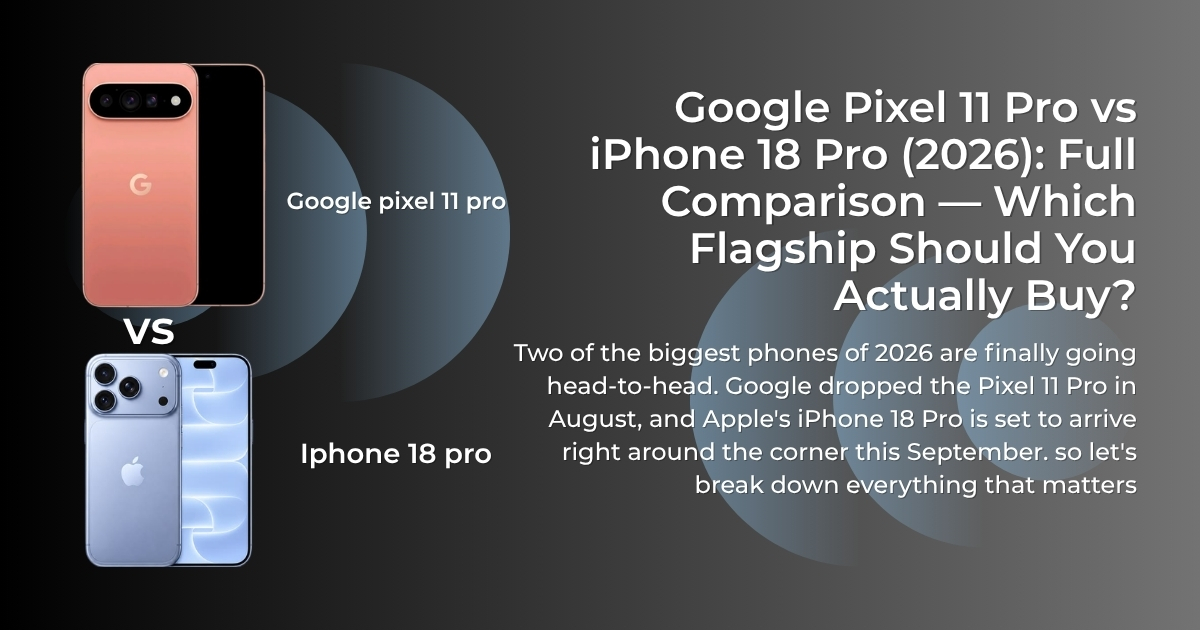
Two of the biggest phones of 2026 are finally going head-to-head. Google dropped the Pixel 11 Pro in August, and Apple’s iPhone 18 Pro is set to arrive right around the corner this September. If you’re someone who saves up for months before buying a flagship, you don’t want to get this decision wrong — so let’s break down everything that matters: design, display, performance, cameras, battery, software, and price, in simple language, no jargon overload.
Let’s be honest — both companies are throwing their best hardware at these phones. But “best” doesn’t always mean “best for you.” So grab a chai and let’s go through this properly.
Quick Comparison Table
| Feature | Google Pixel 11 Pro | iPhone 18 Pro |
| Display | 6.3″ OLED, 120Hz, up to 3300 nits | 6.3″ OLED, ProMotion 120Hz, brighter panel |
| Chipset | Google Tensor G6 | Apple A20 Pro (2nm) |
| RAM | 16GB | 12GB |
| Storage options | 256GB / 512GB / 1TB | 256GB / 512GB / 1TB / 2TB |
| Rear cameras | Triple 48MP setup (main, ultra-wide, telephoto with up to 120x Pro Res Zoom) | Triple 48MP setup (main, ultra-wide, periscope telephoto) |
| Front camera | 42MP ultra-wide selfie camera | Under-display Face ID, smaller Dynamic Island |
| Battery | 4850mAh, 30W wired, 25W wireless (magnetic) | Around 5000mAh+, wired + MagSafe wireless |
| Build | Glass back, aluminum frame, Gorilla Glass Victus 2 | Aluminum + glass rear, Ceramic Shield |
| OS | Android 17, up to 7 years of major updates | iOS with several years of guaranteed updates |
| Starting price | Around 1,19,999 | Around 1,64,900 |
Keep in mind that Apple’s phone is launching just as this comparison goes live, so a few exact numbers may shift slightly once it’s officially out. We’ll update this if anything major changes.
Design and Build Quality
The Pixel 11 Pro keeps the same compact 6.3-inch footprint as its predecessor but gets a genuine glow-up: an edge-to-edge glass back replacing the old half-glass, half-metal design, plus a redesigned camera bar that now looks a lot cleaner. It also has a fun new party trick — a small multi-color LED strip near the camera bar (Google calls it HiLight) that glows in different colors depending on who’s calling or when Gemini finishes a task. It’s a small thing, but it makes the phone feel less robotic and more personal.
The iPhone 18 Pro, on the other hand, is expected to stick close to its predecessor’s design language — same camera plateau, same general shape — but with meaningful refinements underneath. Rumors point to a shrunken Dynamic Island thanks to an under-display Face ID system, and a slightly more premium-feeling rear glass section around the wireless charging area. Apple rarely reinvents the wheel on design every single year, and this generation looks like an “under the hood” upgrade rather than a visual overhaul.
Bottom line: If you like bold design changes and a phone that feels a little different each generation, Pixel wins here. If you prefer Apple’s steady, refined evolution, the iPhone 18 Pro won’t disappoint.
Display
Both phones sit at 6.3 inches, and both push serious brightness numbers this year. The Pixel 11 Pro’s OLED panel goes up to 3300 nits peak brightness with a smooth 120Hz refresh rate, which makes it genuinely usable even under Rajasthan’s harsh afternoon sun. Apple is also expected to jump way up in peak brightness for the iPhone 18 Pro, moving past its already-strong 3000-nit ceiling from the previous generation.
Realistically, both displays will look stunning for everyday use — scrolling Instagram, watching YouTube, or gaming. The difference will mostly come down to color tuning: Pixel tends to lean slightly punchier and more vivid out of the box, while iPhone displays are usually tuned for color accuracy.
Performance
This is where the two ecosystems really diverge. The Pixel 11 Pro runs on Google’s own Tensor G6 chip, which isn’t designed to top benchmark charts — instead, it’s built to power on-device AI features like Gemini Intelligence, live translation, and computational photography really efficiently. If your daily use is mostly social media, camera, calls, and light gaming, you genuinely won’t notice a performance gap.
The iPhone 18 Pro is expected to bring Apple’s A20 Pro chip, built on a next-generation 2-nanometer process — a genuine leap in efficiency and raw power. Apple chips have consistently topped performance charts for years, and this generation is rumored to push things even further, which matters a lot if you’re into heavy gaming, video editing, or professional apps on your phone.
Bottom line: For raw horsepower and long-term smoothness, iPhone still has the edge. For smart, AI-driven everyday tasks, Pixel feels more thoughtful.
Camera Comparison
Camera performance is often the single biggest deciding factor for flagship buyers, and both phones bring serious firepower here.
The Pixel 11 Pro’s camera system includes a 48MP ultra-wide lens with improved low-light performance and a telephoto lens that now supports up to 120x Pro Res Zoom (up from 100x last year). Google has also introduced “Camera Looks,” letting you choose your preferred photo style — more neutral, more vivid, or film-inspired — instead of being stuck with one fixed processing style. For anyone who loves editing and personalizing photos before posting, this is a genuinely useful addition.
The iPhone 18 Pro is rumored to bring variable aperture support to its main camera for the first time, giving you manual-style control over depth of field — something serious mobile photographers have wanted for years. Combined with Apple’s already excellent video capabilities (still the gold standard for vlogging and content creation), this could make the iPhone 18 Pro the stronger pick for anyone shooting video regularly.
Bottom line: Photos — Pixel’s computational photography and zoom range are hard to beat. Videos — iPhone remains the safer choice, especially for creators.
Battery and Charging
The Pixel 11 Pro packs a 4850mAh battery with 30W wired charging and 25W magnetic wireless charging — solid, though not chart-topping numbers. Apple’s iPhone 18 Pro is expected to come with a slightly larger battery along with its usual efficient chip, which historically translates into strong real-world battery life despite smaller battery numbers on paper.
Neither phone is likely to blow you away with ultra-fast charging speeds compared to some Chinese flagships, but both should comfortably get you through a full day of moderate to heavy use.
Software and AI Features
This is genuinely one of the most exciting battlegrounds in 2026. The Pixel 11 Pro ships with Android 17 and a promise of up to seven years of major OS updates — one of the longest support windows in the industry. It’s also the first Pixel to fully integrate Gemini Intelligence, which can handle background tasks like booking a ride, reordering food, or managing your calendar without you lifting a finger.
Apple’s iOS ecosystem remains famously polished and tightly integrated across iPhone, iPad, and Mac. If you’re already using AirPods, a MacBook, or an Apple Watch, the iPhone 18 Pro will simply feel like it “belongs” in that setup in a way Android phones can’t replicate.
Pros and Cons
Google Pixel 11 Pro
Pros:
- Excellent, natural-looking photos straight out of the camera
- Massive 120x zoom range for a phone this size
- Up to 7 years of software and security updates
- Genuinely useful AI features that run smoothly in daily life
- Refreshed, premium-feeling design
Cons:
- Tensor chip still trails Apple silicon in raw performance
- Charging speeds are average, not class-leading
- Smaller global service network compared to Apple in some regions
iPhone 18 Pro
Pros:
- Expected to be the fastest chip in any smartphone this year
- Best-in-class video recording, ideal for content creators
- Tight integration with other Apple devices
- Long track record of reliable, timely software updates
Cons:
- Historically higher price tag, especially with storage upgrades
- Design changes are usually minor and incremental
- Less flexibility and customization compared to Android
Final Verdict: Which One Should You Buy?
If your priority is photography, smart AI features, and getting the longest possible software support without spending a fortune upgrading every two years, the Pixel 11 Pro is the smarter long-term investment. It’s built for people who want their phone to genuinely think ahead for them.
If you care more about raw performance, video quality, and you’re already living in the Apple ecosystem with a Mac or AirPods, the iPhone 18 Pro is worth the extra spend — it’s built to be the most powerful, most polished device in its lineup yet.
Either way, both phones represent the best that Android and iOS have to offer in 2026. The real question isn’t which phone is “better” overall — it’s which ecosystem actually fits how you already live your digital life. Choose that, and you really can’t go wrong.