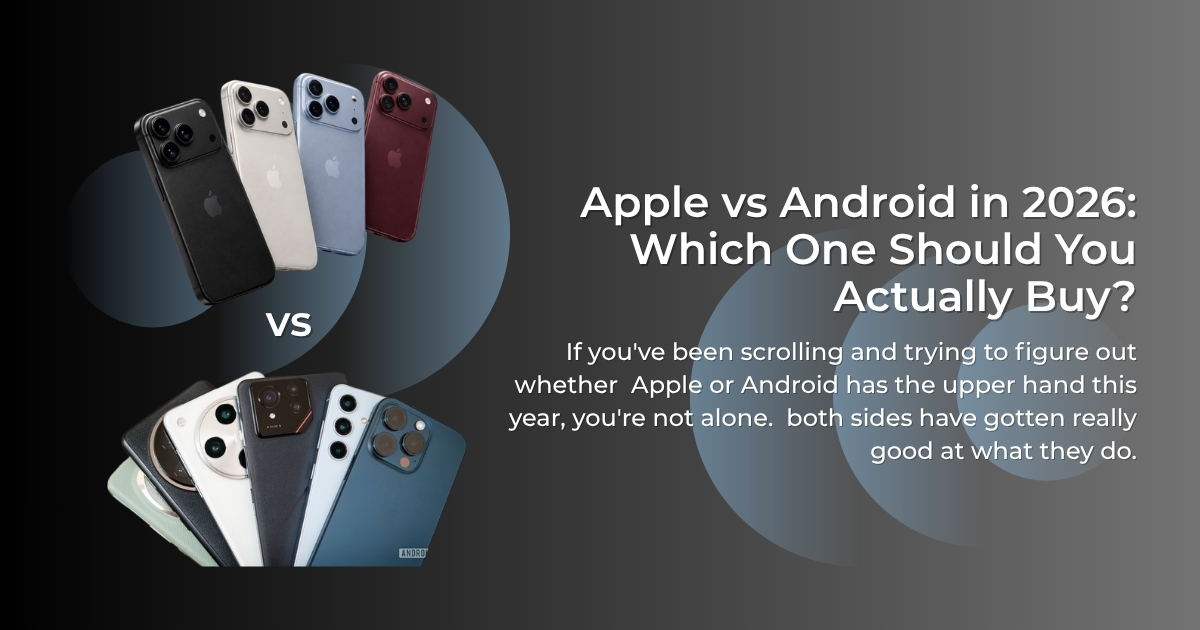
If you’ve been scrolling through phone ads and comment sections trying to figure out whether Team Apple or Team Android has the upper hand this year, you’re not alone. This debate has been running for over a decade, and honestly, it’s not getting any less confusing — both sides have gotten really good at what they do.
So instead of picking a side and shouting about it (there’s enough of that on Twitter already), let’s break this down the way a friend would explain it. No jargon, no fanboy drama, just what actually matters when you’re about to spend your hard-earned money.
The Big Picture First
Before we get into features, here’s the one thing you need to internalize: in 2026, there is no “objectively better” phone operating system. The gap that used to exist — where iPhones were smooth, and Android phones lagged, or where Android had way better customization, and iPhones felt locked down — has shrunk a lot. What’s left is mostly a difference in philosophy, not raw quality.
- Apple’s philosophy: One company builds the chip, the software, and the phone. Everything is tightly controlled so it “just works,” but you don’t get much room to tweak things your own way.
- Android’s philosophy: Multiple brands (Samsung, OnePlus, Xiaomi, Realme, Motorola, and more) build hardware on top of Google’s software, giving you tons of choice at every price point, but with some inconsistency between brands.
Neither is wrong. It just depends on what kind of user you are.
Performance: Is One Actually Faster?
This is where a lot of myths float around, so let’s clear the air.
Apple’s custom chips continue to lead in single-core performance and efficiency, which is a big reason why even a 3-4 year old iPhone still feels snappy for everyday tasks like browsing, messaging, and light gaming. Apple designs the chip and the software side by side, so the two are tuned to work together — that’s the real secret behind why older iPhones age so well.
On the flip side, flagship Android phones have genuinely caught up in raw multi-core power and graphics performance, and in some benchmarks they actually edge ahead of iPhones — especially useful for heavy multitaskers, gamers, and anyone editing 4K video on the go. The catch is that this top-tier performance is mostly limited to flagship and upper-mid-range Android phones. Budget and entry-level Android devices, especially the ones with heavier custom software layers, can still feel sluggish compared to a similarly priced iPhone.
Bottom line: If you’re buying a flagship, both platforms perform brilliantly. If you’re buying budget or mid-range, Android usually wins on raw specs, but a well-optimized iPhone (even an older model) can still outperform a spec-heavy budget Android phone in everyday smoothness.
Cameras and Media
Camera comparisons used to be simple — Apple was consistent, Android was hit-or-miss. That’s changed a lot.
- iPhones are known for colour accuracy, natural skin tones, and — especially — extremely stable, professional-looking video. If you shoot a lot of reels or vlogs, this is where Apple still has an edge that’s hard to ignore.
- Android flagships have pulled ahead in one very specific area: zoom. Several top Android phones now offer serious telephoto capability, some even with attachable or built-in long-range lenses, which iPhones simply don’t match at the same price.
So if video consistency matters most to you, iPhone remains the safer pick. If you’re someone who loves zooming into far-off subjects — concerts, wildlife, street shots — a camera-focused Android flagship might serve you better.
Software, Updates, and Longevity
This is an underrated factor that a lot of buyers ignore until it bites them two years later.
Apple has historically supported iPhones with software updates for five to six years, which is a massive plus if you’re the type who keeps a phone for a long time before upgrading. Meanwhile, Android brands have been closing this gap fast — some flagship Android phones now promise up to seven years of software support, which was unheard of a few years ago. The catch is that this generous support window is usually reserved for flagship models; budget and mid-range Android phones still tend to get shorter update cycles.
Ecosystem: The Real Deciding Factor for Many Buyers
Here’s something people underestimate until they’re deep into one ecosystem: switching later becomes painful.
If you already own a laptop, tablet, smartwatch, or earbuds from one brand, sticking with the matching phone platform often makes daily life smoother — file sharing, notifications, and syncing between devices tend to work more seamlessly within the same ecosystem. Apple’s ecosystem is famous for this kind of seamlessness between iPhone, iPad, and Mac. Android’s version of this exists too (especially within a single brand like Samsung), but it’s a little less “magic” simply because Android hardware comes from many different manufacturers rather than one company controlling every piece.
Pricing Reality for Indian Buyers
Let’s be real — for most of us, this is the section that actually decides the purchase.
Android’s biggest strength is choice. You can walk into any price bracket — ₹8,000, ₹15,000, ₹30,000, ₹60,000+ — and find a genuinely solid Android option built for that budget, often with big batteries, fast charging, and generous storage that would be unthinkable on an iPhone at the same price.
iPhones, meanwhile, are priced higher in India due to import duties and currency factors, so even a “budget” iPhone often costs more than a mid-range Android phone with better specs on paper. This is exactly why the second-hand and certified-refurbished iPhone market has exploded in India — buyers get the Apple experience, camera quality, and longevity at 30-60% lower cost, without the risk of a shady grey-market device (as long as you buy from a trusted, warranty-backed refurbisher).
If your budget is fixed and you want the best specs for that money, Android gives you way more flexibility. If you want the Apple experience without paying full price, refurbished iPhones have become a legitimate, popular middle path.
Quick Pros and Cons
Apple / iOS
Pros:
- Long software support (5-6+ years)
- Extremely stable, efficient performance even on older hardware
- Best-in-class video recording and colour consistency
- Strong privacy and security controls
- Great resale value
Cons:
- Higher upfront cost in India due to duties and taxes
- Limited customization compared to Android
- Fewer choices across price segments
- Storage and accessories can get expensive
Android
Pros:
- Massive range of options across every budget
- More customization and flexibility
- Faster charging speeds and bigger batteries on many models
- Leading zoom and camera hardware on flagship models
- Better value-for-money on paper specs
Cons:
- Software update support still varies a lot by brand and price segment
- Performance consistency drops in budget models
- Ecosystem experience is less unified across brands
- Resale value is more unpredictable outside a few popular brands
So, Which One Should You Actually Buy?
Here’s the honest, no-fluff answer: it depends on your priorities, not on which platform is “better.”
- Want the smoothest experience, best video quality, and don’t mind paying a bit more (or going the refurbished route to save money)? Go Apple.
- Want the most features, flexibility, and value for your specific budget, and don’t mind researching a bit before you buy? Go Android.
- On a tight budget and want maximum specs for your money? Android wins, hands down.
- Already own other Apple devices and want everything to sync effortlessly? Stick with iPhone.
There’s no universal winner in 2026 — just the right phone for the right person. And honestly, that’s good news for you as a buyer, because it means you’re not stuck with a “bad” choice either way. Figure out your budget, your must-have features (camera, battery, gaming, ecosystem), and let that guide the decision rather than brand loyalty alone.
Whatever you choose, make sure you’re buying from a trusted seller, checking warranty terms carefully, and not getting swayed purely by flashy marketing. That’s really the difference between getting a great deal and getting stuck with buyer’s remorse.