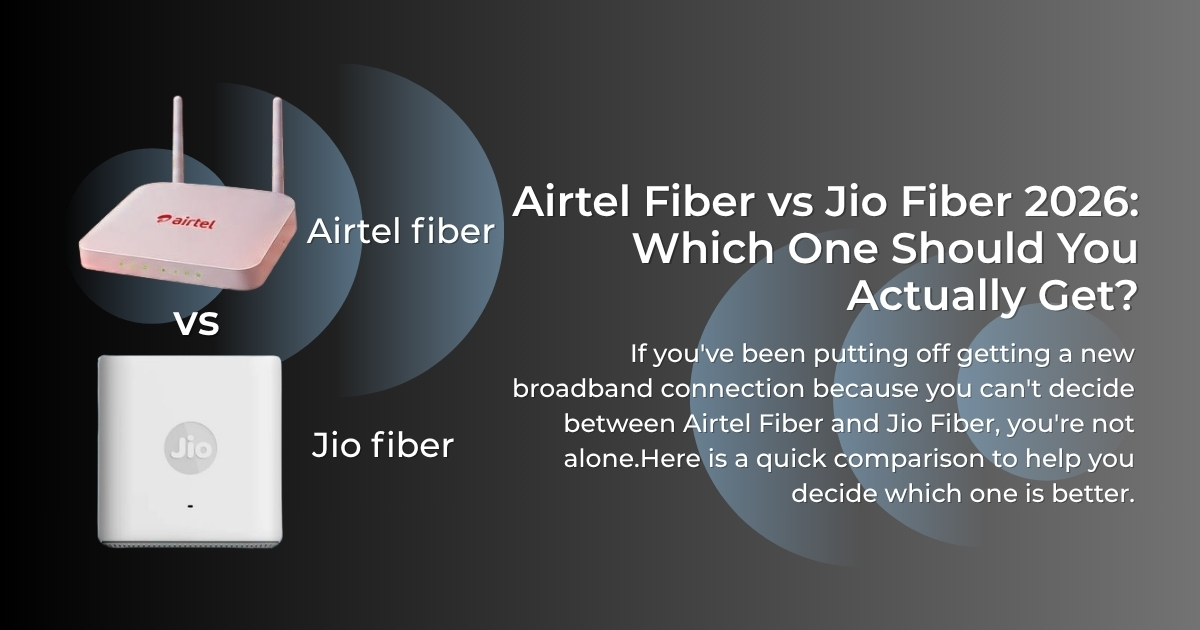
If you’ve been putting off getting a new broadband connection because you can’t decide between Airtel Fiber and Jio Fiber, you’re not alone. Both have gotten a LOT better over the last couple of years — faster entry-level speeds, bigger OTT bundles, and prices that keep shifting every few months. So instead of just throwing numbers at you, we’re breaking this down the way we’d explain it to a friend who’s about to sign up for a new connection: what you’re actually paying for, what you’re getting in return, and which one fits your situation.
Let’s get into it.
What Makes Fiber Internet Different Anyway?
Both Airtel and Jio also sell 5G-based wireless home broadband (Airtel Xstream AirFiber and Jio AirFiber), but this post focuses on their actual fiber-optic (FTTH) connections — the wired kind that runs an optical cable straight into your home. Fiber gives you much higher speeds, lower lag, and a connection that doesn’t slow down just because ten other people in your building are streaming at the same time. Once you’ve used proper fiber broadband, going back to old-school copper broadband feels painfully slow.
Airtel Fiber vs Jio Fiber: Plans and Pricing (2026)
Prices change often, so always double-check on the official apps before you commit — but here’s how the current lineup generally shapes up, tier by tier (prices are exclusive of GST):
| Plan Tier | Jio Fiber Speed | Jio Fiber Price | Airtel Fiber Speed | Airtel Fiber Price |
| Entry | 30 Mbps | ₹399/month | 40 Mbps | ₹499/month |
| Mid | 100–150 Mbps | ₹699–₹999/month | 100 Mbps | ₹799/month |
| High | 300 Mbps | ₹1,499/month | 100–200 Mbps | ₹899–₹1,099/month |
| Premium | 500 Mbps | ₹1,999/month | 300 Mbps | ₹1,599/month |
| Top-tier | 1 Gbps | ₹2,499/month | 1 Gbps | ₹3,999/month |
A couple of things worth noting here. Jio’s entry plan is cheaper, but Airtel’s starting speed is technically a bit higher (40 Mbps vs 30 Mbps). Once you go above 100 Mbps, the two are fairly close in day-to-day performance for most households. But at the very top end — the 1 Gbps plans — Jio is noticeably cheaper, undercutting Airtel by well over a thousand rupees a month for the same headline speed.
Also keep an eye on installation costs: Jio typically bundles in a free router and set-top box with no upfront charge, while Airtel usually waives installation only if you pay for a few months in advance — otherwise you might be asked for a refundable deposit that gets adjusted against your bill later.
Features and OTT Bundles: Where Each One Wins
Jio Fiber Highlights
- Free Wi-Fi router on most plans
- A 4K-capable set-top box with a large channel line-up on many plans
- OTT bundles that can include Netflix, Amazon Prime, JioHotstar, SonyLIV, ZEE5, YouTube Premium, and more on higher tiers — genuinely one of the most generous entertainment bundles in the market
- Symmetrical upload speeds, which is a real plus if you’re a content creator, freelancer, or anyone who regularly uploads large files
- Built-in gaming and smart home features through its apps and set-top box
Airtel Fiber Highlights
- A reputation for steadier, more consistent connections, especially in established metro areas
- Extra bundled perks on select plans like cloud storage, productivity tools, and health platform access
- An Xstream Android box with a voice remote on select plans
- Generally faster complaint resolution and more predictable technician visits
- Slightly better real-world latency, which matters a lot for online gaming and video calls
Pros and Cons
Jio Fiber
Pros:
- Cheaper across almost every comparable plan tier
- Bigger OTT app bundle for the price
- Wider availability, especially outside metro cities
- Symmetrical upload speeds are great for uploads and video calls
- Free router and set-top box on most plans
Cons:
- Users in some newer service areas occasionally report connection instability
- Support and technician visit times can be less predictable, especially in smaller towns
- Slightly higher latency, which competitive gamers may notice
Airtel Fiber
Pros:
- Strong reputation for network stability, especially in busy evening hours
- Faster, more professional customer support experience
- Lower latency, a real advantage for gaming and video conferencing
- Useful bundled extras like cloud storage and productivity app subscriptions on higher plans
Cons:
- More expensive at almost every tier, and noticeably so at the top end
- Coverage is more concentrated in metros and Tier 1 cities, expanding gradually elsewhere
- Router/installation may need an upfront deposit unless you pay in advance
Which One Should You Choose?
Here’s the honest way to think about it:
Go with Jio Fiber if you:
- Want the best rupee-to-value ratio
- Care a lot about OTT app variety without paying extra
- Live in a smaller city or town where Jio’s network is more widely available
- Upload files often or stream content yourself
- Are eyeing the 1 Gbps plan and want to save real money
Go with Airtel Fiber if you:
- Need a connection that simply doesn’t drop, especially for work-from-home or online classes
- Play competitive online games where every millisecond of latency counts
- Want faster support response when something goes wrong
- Don’t mind paying a bit more for consistency and extra bundled perks
Frequently Asked Questions
Is Jio Fiber cheaper than Airtel Fiber in 2026? Yes, generally. Jio’s entry plan starts around ₹399/month compared to Airtel’s ₹499/month, and the price gap widens further at higher tiers, especially at the 1 Gbps level.
Which one has better speed? Both top out at 1 Gbps on their highest plans. Airtel’s entry-level plan is slightly faster on paper, but from the 100 Mbps tier upward, both perform similarly for typical streaming, gaming, and work-from-home use.
Do both include free OTT subscriptions? Both bundle OTT apps starting from their mid-tier plans, but the exact apps and number vary by plan and sometimes by region — always check the specific plan details before subscribing.
Which is better for gaming or video calls? Airtel tends to have a slight edge in latency and consistency, which matters more than raw speed for real-time activities like gaming or video conferencing.
Can I switch providers later if I’m not happy? Yes, there’s no lock-in preventing a switch. Just remember that moving from one provider to another usually means a fresh installation, so factor in the time and any deposit involved.
Final Word
There’s no single “best” broadband here — just the one that’s best for you. If you want maximum value, the widest OTT bundle, and don’t mind occasional hiccups, Jio Fiber makes a very strong case. If uptime, support quality, and low latency matter more to you than saving a few hundred rupees, Airtel Fiber is worth the slight premium.
Before you commit to either, check availability at your exact address using the PIN code tool on each provider’s website or app — coverage maps can be optimistic, and it saves you a lot of back-and-forth later.